


Abstract
Pretrained Video Diffusion Transformers encode rich spatiotemporal priors from large-scale videos, making them promising backbones for robot control. However, efficiently adapting them into World Action Models remains challenging. Existing approaches reduce video-adaptation or action-prediction costs, but it remains unclear whether representations produced during future-video adaptation can directly support lightweight action prediction.
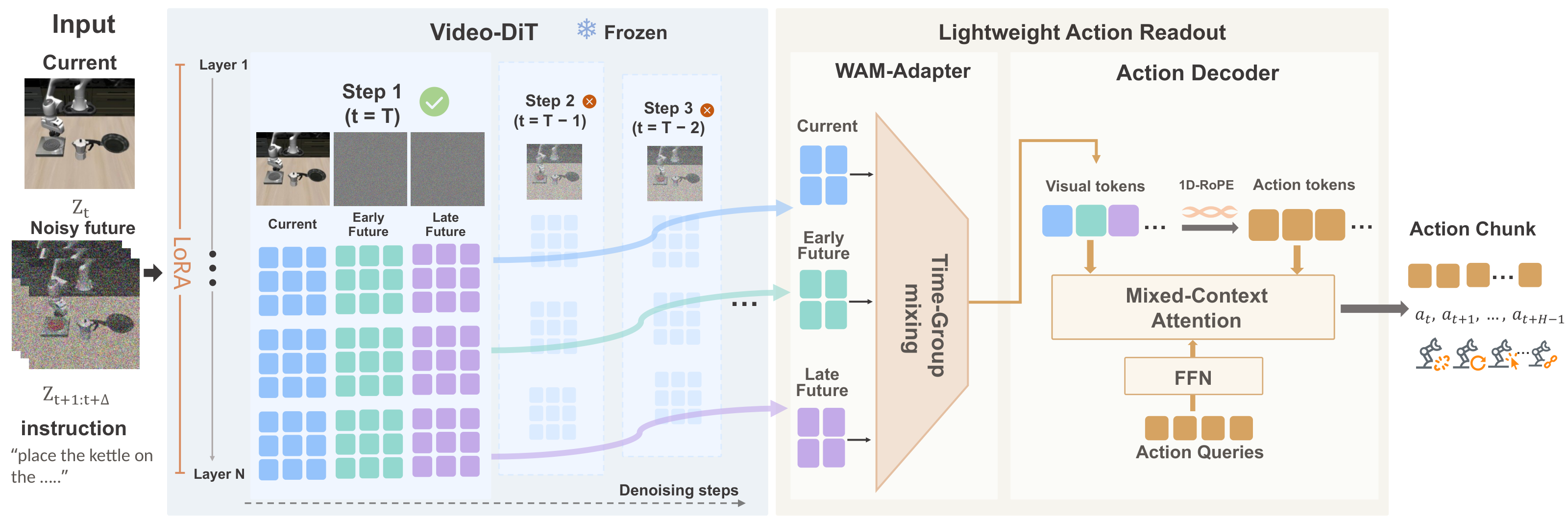
To address this gap, we propose WAM-Adapter, a parameter- and training-efficient framework that freezes the Video-DiT backbone, adapts it with LoRA, and reuses multi-layer representations for action prediction. A lightweight readout organizes multi-layer K/V representations from current-and-future processing into Current, Early-Future, and Late-Future groups, applying group-specific cross-layer fusion for action-chunk prediction. Inference requires a single Video-DiT forward over the current observation and noisy future slots, without future-video generation or iterative action denoising.
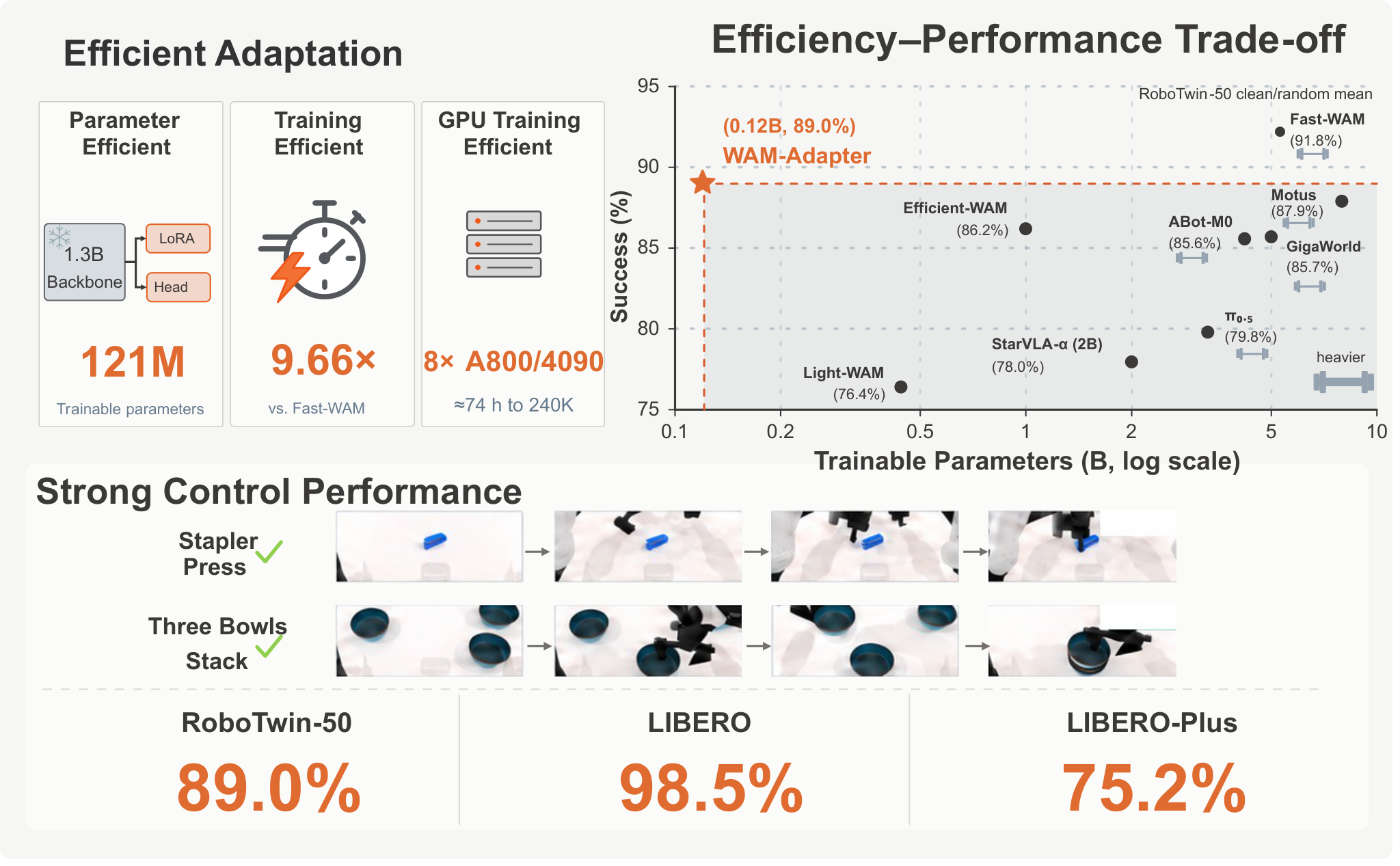
Without embodied pretraining, WAM-Adapter uses only 121M trainable parameters with a compact Wan-1.3B backbone, achieving 89.0% success across 50 RoboTwin 2.0 tasks, 98.5% on LIBERO, and 75.17% on LIBERO-Plus. To our knowledge, this is the smallest reported trainable-parameter budget for directly trained WAMs without embodied pretraining. Under the same setting, WAM-Adapter improves training throughput by 9.66× while using 98% fewer trainable parameters than Fast-WAM. These results show that Video-DiT representations formed during world-model adaptation can be efficiently reused for strong robot control.
Method
A frozen Video-DiT, a single joint current+future forward, and a lightweight temporal-group readout that predicts the whole action chunk directly.
1. Frozen Video-DiT + LoRA
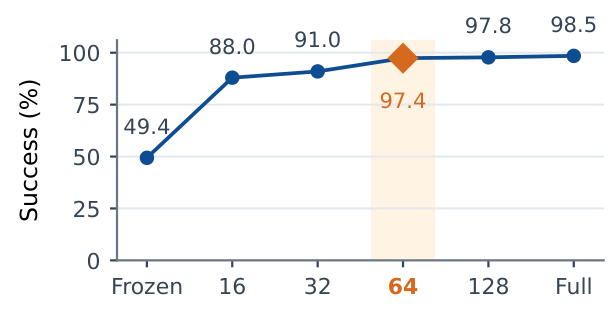
The pretrained Wan2.1-T2V-1.3B backbone keeps its spatiotemporal priors intact. Rank-64 LoRA adapts it to robot data, so only 121M parameters are trainable — no full backbone fine-tuning, no embodied pretraining.
2. One Joint Current+Future Pass
The clean current frame and a few noisy future latent slots (τ = 1) are processed together in a single Video-DiT forward. There is no future-video denoising loop and no additional action-side Video-DiT forward.
3. Temporal-Group Cross-Layer Readout
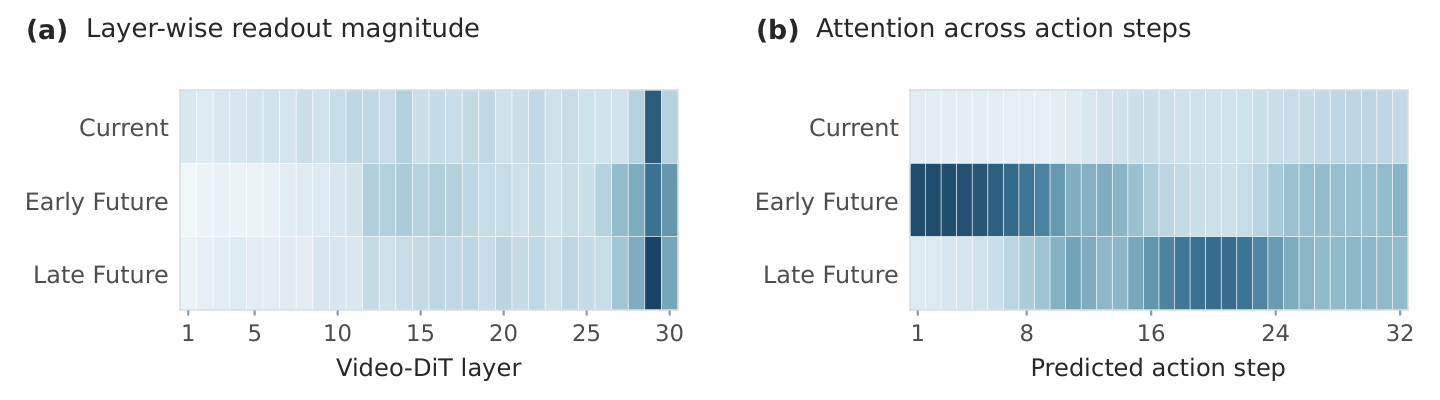
The readout keeps the temporal identity of the representations as Current, Early-Future, and Late-Future groups, learns group-specific cross-layer fusion weights, aligns fused keys to the action timeline, and predicts the chunk with a small mixed-context decoder.
Results
Strong control performance with the smallest reported trainable-parameter budget among directly trained WAMs without embodied pretraining.
Main Results
Success rates and efficiency
Analysis
Adaptation, readout and real-world behavior


BibTeX
The arXiv release is coming soon; for now please cite the project as:
@article{wamadapter2026,
  title   = {WAM-Adapter: Efficiently Adapting Video-DiT World Representations to Robot Actions},
  author  = {Liu, Dongxu and Li, Zhe and Ke, Zundong and Zhang, Zhipeng},
  journal = {arXiv preprint},
  year    = {2026},
}